Independence Day of Central African Republic | 13th August
August 13, 2026
Independence Day of Central African Republic | 13th August
Today, the Central African Republic celebrates its National Day.
Independence Day is a public holiday in CAR on August 13th each year. It marks full independence from France on this day in 1960.
WAELE AFRICA Foundation joins the people of the Central African Republic in celebrating this milestone. We wish you peace, unity, and progress as you continue to build a stronger nation.
History of Independence Day in the Central African Republic
CAR is a landlocked state in the heart of Africa with a territory of about 622,400 square km and a population of about 4.6 million people.
The country has rich deposits of uranium, oil, gold and diamonds. According to the UN, it remains among the least developed countries in Africa in socio-economic terms.
Due to its inland location, the region had little early contact with Europeans. That changed with the slave trade, which depopulated large areas and disrupted local societies.
By the late 19th century, during the 'Scramble for Africa', France, Germany and Belgium competed for control. France prevailed, and in 1894 set up the dependency of Ubangi-Shari. In 1910, it became part of the Federation of French Equatorial Africa.
After World War II, the push for self-rule grew. In 1946, residents of French Equatorial Africa became French citizens with the right to elect local legislatures.
Barthelemy Boganda, founder of the pro-independence Social Evolution Movement of Black Africa, became the first Central African elected to the French parliament.
With the Fifth French Republic in 1958, the territory achieved self-government within French Equatorial Africa, with Boganda as prime minister.
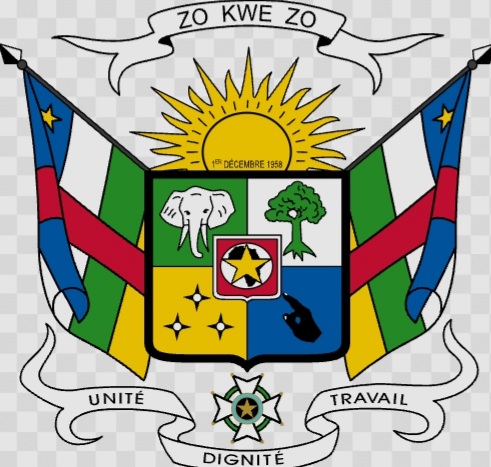
On 1 December 1958, the Assembly declared the birth of the autonomous Central African Republic.
Boganda died in 1959. One year later, on 13 August 1960, Ubangi-Shari gained full independence as the Central African Republic, with David Dacko, Boganda’s nephew, as its first president.
Did you know?
The flag of CAR was adopted on 1 December 1958. It combines the pan-African colors of red, yellow and green with the French Tricolore of red, white and blue. The yellow star represents Boganda’s vision of a large African federation under French protection.




0 Comments